
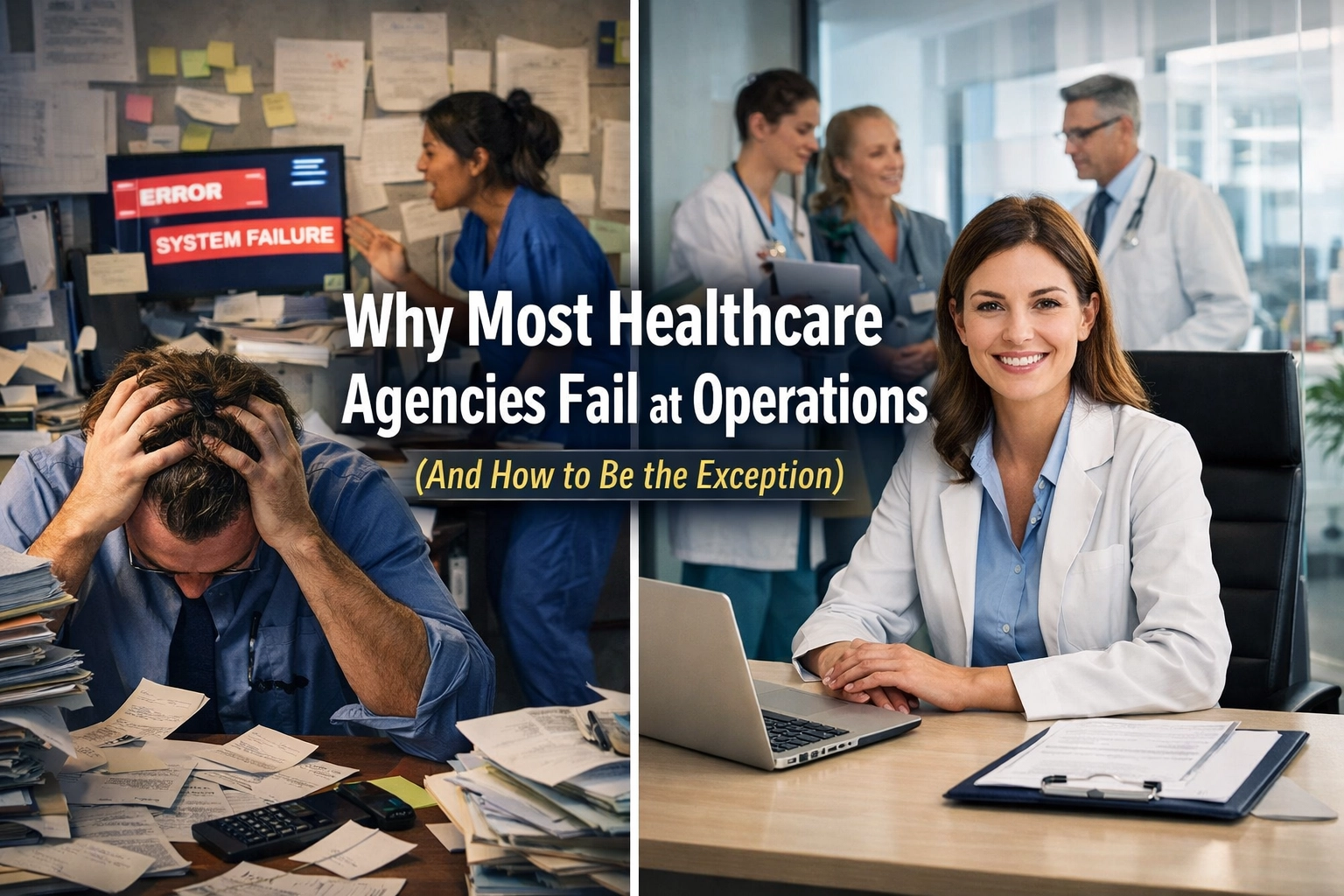
The healthcare landscape in 2026 is defined by a singular, persistent paradox: while the demand for services and staffing is at an all-time high, the failure rate for healthcare agencies remains alarmingly elevated. On the surface, it seems counterintuitive. How can organizations with a steady stream of clients and a desperate market for their services find themselves facing insolvency or operational stagnation?
The answer rarely lies in a lack of clinical expertise or market opportunity. Instead, the downfall of most healthcare organizations is rooted in the "invisible" layers of the business: the operational infrastructure. In a rapidly evolving and dynamic industry, relying on manual processes and reactive management is a recipe for disaster. To achieve healthcare operational efficiency, agencies must move beyond simply "working harder" and begin building systems that deliver predictable, scalable performance.
The Growth Trap: Why Revenue Isn't Always a Safety Net
One of the most dangerous misconceptions in healthcare management is the belief that rising revenue solves all problems. In reality, rapid expansion often acts as an accelerant for existing operational weaknesses. As an agency scales its recruitment and client acquisition, the cracks in its foundation: manual payroll workflows, spreadsheet-based credential tracking, and inconsistent billing: begin to widen.
When these systems fail under the weight of growth, the consequences are immediate and severe. Margin compression occurs when agencies raise clinician pay to meet demand without simultaneously securing higher bill rates from facilities. This erosion of profit margins leaves the organization with no buffer to absorb payment delays or regulatory compliance costs. At LAP Strategies and Consulting, LLC, we frequently observe that many agencies fail while their top-line revenue is still growing, simply because they lacked the 5 essential systems required to manage that growth sustainably.

The Three Pillars of Operational Failure
To become the exception to the rule, leaders must first identify the specific bottlenecks that lead to systemic failure. Through our healthcare consulting services, we have identified three primary pillars where most agencies lose their footing:
1. Margin Erosion and Financial Mismanagement
Agencies often succumb to "pay pressure," increasing compensation for staff to win contracts without a rigorous analysis of their gross margins.
- Inconsistent billing cycles: Delays in invoicing lead to extended Days Sales Outstanding (DSO), which starves the company of necessary cash flow.
- Hidden operating expenses: Failing to account for the rising costs of compliance and insurance can turn a seemingly profitable contract into a financial drain.
2. The "Spreadsheet Ceiling" in Operations
Many agencies rely on manual data entry and disjointed software solutions. While these might suffice for a small team, they become a bottleneck as the organization grows.
- Credentialing bottlenecks: If your compliance team is manually tracking certifications via email and Excel, you are one missed expiration away from a legal and financial nightmare.
- Payroll errors: Inaccurate paychecks erode trust with clinicians, leading to high turnover and increased recruitment costs.
3. Quality and Reputation Decay
Operational failure doesn't just impact the bottom line; it impacts patient care. Studies indicate that agencies with poor operational oversight often see lower clinical performance scores and higher adverse event rates. When systems fail, the quality of staff placement drops, damaging the agency’s reputation with hospital partners and making future contract renewals nearly impossible.
Building Predictable Performance: The LAP SC Framework
Becoming the exception requires a shift from a reactive mindset to a proactive, systems-oriented approach. This is where our framework provides a significant competitive advantage. By eliminating bottlenecks and building predictable performance loops, we help healthcare entrepreneurs move from survival mode to sustainable scaling.

Leveraging Digital Transformation and AI
The integration of advanced technology is no longer optional. Modern healthcare consulting services emphasize the role of digital transformation in streamlining administrative burdens.
- Automated Compliance Tracking: Utilizing AI-driven platforms to monitor credentials in real-time ensures 100% audit readiness at all times.
- AI-Enhanced Revenue Cycle Management: Implementing "AI vs. AI" billing strategies can drastically reduce revenue leakage by catching errors before they result in a denied claim.

Optimizing the Intake to SOC Velocity
Revenue velocity is determined by how quickly an agency can move from initial intake to Start of Care (SOC). If your internal processes are bogged down by administrative red tape, your revenue will always be capped. We focus on optimizing this specific framework to ensure that clinicians are in the field and generating revenue as efficiently as possible.
Transforming Your Agency into a Scalable Asset
Success in the healthcare sector is not about who can work the most hours; it is about who has the most resilient systems. Agencies that invest in professional organizational restructuring are better positioned to handle market volatility and regulatory shifts.
By prioritizing healthcare operational efficiency, you transform your business from a job that requires your constant intervention into a scalable asset that delivers predictable results. This transition is essential for those looking to reach the next revenue milestone, whether that is moving past the $2M revenue stall or preparing for an acquisition.

Frequently Asked Questions (FAQ)
What is the most common operational bottleneck in healthcare agencies?
The most frequent bottleneck is the transition from recruitment to placement. Often, the "Intake to Start of Care" process is manual, causing delays that frustrate clinicians and leave hospital shifts unfilled.
How can I protect my margins during rapid growth?
Protecting margins requires a strict "bill-to-pay" ratio policy. You must ensure that every increase in clinician compensation is matched by a negotiated increase in bill rates, while simultaneously using automation to lower your internal cost-to-serve.
When should a healthcare agency consider professional consulting?
Most agencies reach a plateau when their current manual processes can no longer handle the volume of data and staffing needs. If you find your leadership team spending more time "putting out fires" than focusing on strategy, it is time to seek healthcare consulting services.
How does operational efficiency impact regulatory compliance?
Efficiency and compliance are two sides of the same coin. A streamlined, automated system tracks certifications and regulatory requirements automatically, reducing the risk of human error that leads to fines or loss of accreditation.
Concluding Insights
The path to becoming a top-tier healthcare agency is paved with strategic operational choices. While the market provides the opportunity, your internal systems provide the stability. To avoid the pitfalls that claim so many agencies, focus on the following actionable steps:
- Assess Your Current Infrastructure: Identify where manual data entry is causing delays or errors.
- Invest in Scalable Technology: Move away from fragmented spreadsheets and toward integrated operational platforms that offer real-time data visibility.
- Prioritize Revenue Velocity: Analyze your "Intake to SOC" timeline and eliminate any steps that do not add direct value to the patient or the clinician.
- Align Billing and Compensation: Conduct a thorough audit of your margins to ensure that growth is actually profitable.
- Seek Expert Guidance: Don’t wait for a crisis to fix your foundation. Collaborate with experts who understand the nuances of healthcare organizational restructuring.
Building a resilient healthcare organization is a marathon, not a sprint. By focusing on operational excellence today, you ensure your agency’s relevance and profitability for years to come. If you're ready to build a more predictable future for your business, we invite you to book a strategy call with us to explore how we can optimize your operations for sustainable success.